Friday, May 7, 2010

Chigurgh - No Country For Old Men


"Somewhere out there is a true living prophet of destruction and I dont want to confront him"(McMarthy, 4)
Anton Chigurgh is one of the best villains of modern literature because he brings like a natural disaster he brings this terrible sense of dread and there is nothing we can do to stop him. In the novel, we know he is coming from the quote above but he explodes onto the page in the first chapter when he strangles the deputy to death with his manacles. This is the very first time we are introduced to Anton Chigurgh and it's a scene we do not forget through out the novel. The straightforward way McCarthy describes Chigurgh's actions hits the reader hard but at the same time without emotion. This lack of emotion instills a terror in the reader and in the protagonists that is present in both the novel and film adaptation. Whenever he is on the page or on screen, the viewer knows someone is going to die.
The way Anton Chigurgh kills his victims also adds to his character. We first see him kill the deputy with his manacles but it seems that he main weapon of choice is what they use to slaughter cows. A very unique killing tool, that makes it seem that to Chigurgh his victims are nothing more than cattle to be slaughtered. The first time we see him use it is in the scene below:
"The man stepped away from the vehicle. Chigurgh could see the doubt come into his eyes at this bloodstained figure before him but it came too late. He places hi hand on the man's head like a faith healer. The pneumatic hiss and click of the plunger sounded like a door closing. The mans slid soundlessly to the ground, a round hole in his forehead from which the blood bubbled and ran down his eyes carrying with it his slowly uncoupling world visible to see. Chigurgh wiped his hand with his handkerchief. I just didnt want you to get blood on the car, he said" (Chigurch, 7).
Another method Chigurgh uses is to ask his victims to flip a coin. His ease in killing has created a God-plex that he basically admits to Moss's wife before he kills her, saying, "Even a nonbeliever might find it useful to model himself after God" (McCarthy, 256). He could let her go, his word was to a dead man, but he is choosing not to because he has that power. Their exchange on the subject goes as follows:
"Call it.
I wont do it.
Yes you will. Call it.
God would not want me to do that.
Of course he would. You should try to save yourself. Call it.THis is your last chance.
Heads, she said.
He lifted his hand away. The coin was tails.
I'm sorry.
She didnt answer.
Maybe it's for the best.
She looked away. You make it like it was the coin. But you're the one.
It could have gone either way.
The coin didn't have no say. It was just you.
Perhaps. But look at it my way. I got here the same way the coin did" (McCarthy, 258)
When she begins to cry and begs him to spare her, Chigurgh finally tells her, "You're asking that I make myself vulnerable and that I can never do. I have only one way to live. It doesn't allow for special cases" (McCarthy, 259). Chigurgh lives his life as a sort of angel of death, not allowing for mercy when he has deemed that a person's time has come.
In the novel it is more clear that Chigurgh is a hitman and who he is working for. In the film, although they say he is a hitman, that seems to fade in the destruction and death that follows him. He seems to be a wanderer of death that is controlled or sent by no one. I prefer the latter, thinking it to be more terrifying, but the first is more realistic.

Hannibal Lecter - Silence of the Lambs


The infamous "Hannibal the Cannibal" (Harris, 4) has been one of the most fascinating villains in all of literature and film. He has the capacity of not only getting into the minds of the fictional characters but also the audience's mind. And yet, he is in less than ten chapters of the novel, "Silence of the Lambs", and has only sixteen minutes of screen time in the film by the same name. He is a villain, but not the one the protagonist, Clarice Starling, and the FBI are after. That is the power of Hannibal Lector. He does not have to be physically present to have a profound menacing effect on others. He can be locked away for years and yet his words continue to feast upon the minds of not only Crawford and Starling but our minds as well.
So why and how is this possible? What makes Hannibal Lecter so captivating? I would argue that he is two sides of the same coin of society. On the one hand, he is a genius with a "cultured voice" (Harris, 16), and a supporter of the arts. In conversation he is polite and well mannered. He is the exact opposite of the savageness that the word "cannibal" brings to mind. It is this side of him that is particularly dangerous. It makes those around him, and the reader to an extent, trust him, listen to him, even like him. This makes it easy for Lecter to show his other side when his victim lets their guard down. An example of this would be the picture of (what's left of) the nurse who Lecter attacked, "his pulse never [getting] over eighty-five, even when he swallowed [her tongue]" (Harris 12). Hannibal Lecter is a paradox - a cultured "monster" (Harris, 6).
Even when he isn't attacking people physically, he uses their personal details and memories to play mind games. In the case of Starling, he had information she wanted, he mocked her, challenged her - but it was the one moment when he did not do this when their fingers touched and he thanked her "is how he remained in Starling's mind. Caught in the instant when he did not mock. Standing in his white cell, arched like a dancer, his hands clasped in front of him and his head slightly to the side" (Harris, 231). In the next three chapters Lecter brutally kills two officers, taking the face of one to escape.
Hannibal outshines Jame Gumb because of he seems to already know everything about Buffalo Bill before even reading the case file. He easily points out Jame Gumb's psychological issues and exposes his fragility before we even have a scene with him. On the other hand, Lecter's only weakness seems to be his desire to outsmart everyone around him - that he is arrogant. This is a relatable weakness, one that the audience can understand more than Gumb's psychological issues, and so it is often dismissed or forgotten.
The differences between Hannibal in the film and novel are minor in my opinion but they are present. In the film, his arrogance is shown to us while in the novel Jack Crawford points it out during a conversation with Clarice. Anthony Hopkins' fantastic performance brings Lecter to life in a most terrifying way. I would say that the only major difference is that the moments between Clarice and Lecter are more subtle. When they touch fingers it is not as clear that is the moment when he will remain stuck in her mind. But the duality between civilized and monster is very present and I would argue that his exchanges with Jodi Foster are the best scenes in the movie. Their first meeting stands out in particular. The way he is standing in the middle of the room, waiting for her, already an all knowing predator.

Sunday, April 18, 2010

Tyler Durden: Fight Club


When I chose to include "Fight Club" and Tyler Durden in this Independent Study, I wanted to explore the idea of villainy of the self. Where a character, in this case the narrator, creates an alternate personality that becomes self destructive. Because of the constraints of society, the narrator believed that he wasn't capable of making a difference, of having certain qualities, so he created Tyler Durden. The narrator says, "I love everything about Tyler Durden, his courage and his smarts. His nerve. Tyler is funny and charming and forceful and independent, and men look up to him and expect him to change their world. Tyler is capable and free, and I am not" (174). In the movie, Brad Pitt as Tyler Durden tells Edward Norton, the narrator, that he looks the way the narrator wants to look, acts the way he wishes he could act, and even fucks the way he wishes to fuck. So why not just let Tyler take over? Why not be this entity that he created? Tyler is his hero at the beginning but his actions quickly spun out of control until the narrator realized this wasn't what he wanted to be doing and the only way to end it was to shoot himself.
It is precisely because Tyler Durden is the narrator's hero at the beginning of the novel that makes him such a great villain. Palehniuk's writing style slams us over the head with the dreariness of the narrator's situation. It's a very similar feeling to the beginning of "American Psycho," the suffocation of the superficial, trying to find perfection in material things, in Ikea magazines. So when the narrator says, "Deliver me, Tyler, from being perfect and complete" (46) we want it too. The change of tone in the narrator's voice also makes us go along with Tyler's ideas for awhile. "Maybe self improvement isn't the answer. Tyler never knew his father. Maybe self destruction is the answer" (49). And even though we see these guys beating each other to a pulp, just the change in their lives - the fact that they actually seem to be feeling something, makes us also hold Tyler up on this pedestal.
This idealism in such a nihilistic message sets us up for what is coming and we dread the direction the story begins to play out. But it isn't until the death of Bob that the realization of what the narrator has created and supported really hits home. And Tyler becomes something terrifying the narrator has to stop.
Marla Singer is an interesting topic point when it comes to comparing Tyler Durden in literature and film. In the movie, it seems like Tyler Durden doesn't care or really want Marla at all beyond sex. But Edward Norton, as the narrator, comes to really care for her. And when he basically tells Marla that he is not Tyler Durden, Tyler seems to have no qualms with just wanting to get rid of her because she knows too much. However, in the novel, it begins by saying in the first chapter, "I know all of this: the gun, the anarchy, the explosion is really about Marla Singer... We have sort of a triangle thing going here. I want Tyler. Tyler wants Marla. Marla wants me. I don't want Marla, and Tyler doesn't want me around, not anymore. This isn't about love as in caring. This is about property as in ownership. Without Marla, Tyler would have nothing" (14). This basically sets up the novel to revolve around the narrator and Tyler's relationships with Marla. While in the movie, although important, seems to not be the center of the story except at the beginning and then at the very end. In the movie the narrator says, "it has something to do with Marla Singer" not that Tyler hs nothing without her or that it IS about Marla. This makes Tyler's character in the novel more layered because total destruction of society isn't his only goal. If he wants to "own" Marla like "property" then, in a way, this goes against his anti-consumer message as well as the idea that no one is special.
The different endings say more about the narrator than Tyler Durden. In both, the narrator shoots himself and "kills" Tyler Durden but in the film, he talks to other Project Mayhem members and watches the explosions while holding hands with Marla. It almost seems like they will have a happy ending. But in the book, he is in a mental institution, where he refuses to "return" because people still whisper to him "We look forward to getting you back" (208). To me, that shows that the narrator is afraid of Tyler coming back.

Sunday, March 28, 2010

Patrick Bateman: The Psycho on screen and on the page


Patrick Bateman. He is arguable more infamous than Alex from "A Clockwork Orange" even though it is unclear whether his murders are real or all in his head. Why, then, does Patrick Bateman terrify us? My argument is that it's because on the outside he is everything society tells us we want to be: handsome, rich, successful at his job, fashionable, and is engaged to a beautiful woman that will give him even more social standing. But underneath his moisturized skin, Patrick Bateman is the exact opposite. He is a racist, misogynist, necrophiliac, rapist, murderer, and cannibal. He is the ultimate satire of greedy yuppie culture that was particular apparent in the 80's. But more than that, Patrick Bateman is frightening because whether or not he actually committed these acts, he could be the handsome man next you on the subway thinking these thoughts.
In most children stories, and especially in Disney Films, the villain has physical attributes of ugliness or a color palate of darker tones to show their role. For example, Scar is darker than the other lions in "The Lion King" and has a scar, while Simba and Mufasa have no wounds and are of a more golden color. Although the Evil Stepmother is beautiful at the beginning she still wears dark robes and turns into an old hag when she tries to kill Snow White herself. Ursala always appeared to be unattractive in "The Little Mermaid." Jafar, as well, had a large nose, mustache, and dark robes and then later transforms into a giant snake and then demon-like Genie. My point is that they are clearly identifiable. But Patrick Bateman is anything but that. First of all, he is attractive. In multiple chapters he lays out for us his hygiene routine in great detail. For example, on 106, we get to see the contrast between the attractive surface and the serious problems hiding underneath: "Before leaving my office for the meeting I take two Vallium, wash them down with a Perrier and then use a scruffing cleanser on my face with premoistened cotton balls, afterwards applying a moisturizer. I'm wearing a wool tweed suit and striped cotton shirt, both by Yves Saint Laurent, and a silk tie by Armani and new black cap-toed shoes by Ferragamo. I Plax then brush my teeth and when I blow my nose, thick, ropy strings of blood and snot stain my forty-five-dollar handkerchief from Hermes that, unfortunately, wasn't a gift. But I've been drinking close to twenty liters of Evian water a day and going to the tanning salon regularly and one night of binging hasn't affected my skin's smoothness or color tone. My complexion is still excellent. Three drops of Visine clear the eyes. An ice pack tightens the skin. All it comes down to is: I feel like shit but look great."
But despite all of this hard work, the extensive workout routines, the many products for the skin and hair, Patrick Bateman has less of a name than his clothes do. All of the Wall Street characters in this novel can name almost every piece of clothing that the other characters are wearing but they cannot remember the names of their colleagues. Surface is all that people put importance into and yet no one seems to have their own identity, not even the narrator of the book. Example: "Owen has mistaken me for Marcus Halberstam (even though Marcus is dating Cecelia Wagner) but for some reason it doesn's matter and it seems a logical faux pas since Marcus works at P&P also, in fact does the same exact thing I do, and he also has a penchant for Valentino suits and clear prescription glasses and we share the same barber at the same place, the Pierre Hotel, so it seems understandable; it doesnt irk me" (Ellis, 89).
When the only thing that seems of value becomes meaningless we begin to feel the hopelessness Patrick Bateman feels. The movie, and Christian Bale's performance, does a great job of hitting all of the surface points - the business card scene, naming the designer clothes, the hygiene scene is particularly on key. The credits are even a throw back to all of the ridiculous menu items named in the novel. But what it misses is the suffocation that the reader really begins to feel along with Bateman in the first hundred pages or so of the novel. Up until that point nothing graphically violent is mentioned. It is just a grinding of these surface details, again and again and again. And when Bateman does start saying violent things, then confessing his crimes, and no one listens or just thinks he is joking around, it becomes even more suffocating. The movie, on the other hand, goes straight into Bateman yelling at a waitress, "You're a fucking ugly bitch. I want to stab you to death, and then play around with your blood." The pacing of the movie and the book is different. Patrick Bateman's psychological deterioration is linear in the novel, really taking off after the first 250 pages when he begins to start saying things like, "‘You know, guys, it’s not beyond my capacity to drive a lead pipe repeatedly into a girl’s vagina,’ I tell Van Patten and McDermott, then add, after a silence I mistake for shock, finally on their parts an acute perception of my cruelty, ‘but compassionately.’ ‘We all know about your lead pipe, Bateman,’ McDermott says. ‘Stop bragging’" (Ellis, 325). While the movie begins with that outrageous quote then settles back down into his hygiene routine and then speeds back up again.
But I would say that so far, Patrick Bateman is the character that has been translated on screen most successfully. The voice overs and having him be the star of every scene makes us just as conflicted at the end of the movie as we are in the novel about whether he actually committed these heinous acts. Christian Bale's performance is really incredible. He was able to bring to life this terrifying character but also portray his suffering in this world where every door "IS NOT AN EXIT” (Ellis, 399).

Monday, February 22, 2010

Film vs. Literature: Alex from "A Clockwork Orange"


If you look up "Top Villain" lists, whether it be film or literature, Alex will most like be there and, in many cases, one of the top spots. My personal interest in Alex is his transition from victimizer to victim, as well as the question of whether a villain can be "cured" of his violent thoughts and tendencies. In this post, I will also be discussing the differences between Alex in the mediums of literature and film. Stanely Kubrick uses the American edition of the novel, which omits the last chapter of the original story. This chapter not only sets a different tone for the entire novel but also changes view of the audiences on what Alex will do and be like in the future.

Alex from the Novel
We immediately get a sense of who Alex is just from his language - the slang, Nadsat. We are immediately distanced from him, we know he is different from us. It also makes me less aware of just what Alex and his droogs were doing until I got the hang of the slang. For example, I had to look up that "tolchock"(Burgess, 10) meant "to hit."
The first thing I noticed about Alex and his brutality was that he was very judgmental of those around him and how they committed their own acts of violence. His rivalry with Dim and Georgie really showed how he thought he was different from those around him. Although they all indulged in the same gruesome acts, Alex compared his acts of violence to music and art, as if violence was another genre, his genre, of the arts. One of the first times we see this comparison is when Alex is describing the rape of the writer's wife, "So he did the strong-man on the devotchka, who was still creech creech creeching away in very horrorshow four-in-a-bar, locking her rookers from the back, while I ripped away at this and that and the other, the others going haw haw haw still, and real good horrorshow groodies they were that then exhibited their pink glazzies, O my brothers, while I untrussed and got ready for the plunge" (Burgess, 27). Alex is not concerned with what his actions do to other people, he does not associate the consequences of his actions to the actions itself. Even when he finds out what happens to some of his victims later, it is as if he doesn't realize it was because of him that they died. What he is concerned about is the pleasure he receives from violence and music and how he goes about committing the acts. To Alex, Dim is less than him, even though they commit many of the same acts, because he is "vulgar"(Burgess, 32) and stupid. On the other hand, Georgie relies too much on his intellect instead of impulse, according to Alex. In the first part of Part One, Alex's natural instincts as a leader garner him success. But, it is this impulse over intellect reasoning that gets him arrested when Dim and Georgie betray him.

Alex is most fearsome in part one. In the small pong of his fellow droogs, he has the power. And he uses that power to commit very heinous crimes without regret or apology. He thinks he above the law, better than the law. He is naive, and we see him for what he is, a bored child, when he is arrested and becomes the victim of the State. Each part begins with the same question, "What's it going to be then, eh?" But each time, the question has a different tone. The first part is full of confidence, there is an excitement for what the night will bring. The second part, when Alex goes to the State Jail, it is more like "what are you going to do, now?" a more desperate feeling. And indeed, Alex has to fight off daily beatings not only from his fellow inmates but also the prison guards. Part Two and Three bring to the forefront the battle between the current government and political dissidents. Alex becomes an individual caught up between the two sides, who both want to use him as a pawn and, if need be, sacrifice him for their own ideas and philosophies. Neither is really concerned with morality but achieving their own ends.

Ludovico's Technique is interesting to consider when looking at villainy, for it did stop Alex from committing violence and thinking violent thoughts but only because it caused him physical pain not because he thought it was morally wrong. He could also no longer listen to music since he associated it with his violence. This just takes away his free will, it doesn't "cure" him of his nature. The question of what morality wants and "What God wants" seem to different than what the government wants. To the government, as long as a criminal is kept from doing bad things it doesn't matter whether he chooses to do so out of free will. Although, I would argue that Alex is a naive child throughout most, if not all, the novel, he does raise a point when he asks, "hey don’t go into the cause of goodness, so why of the other shop?" (Burgess, 44) It is true that as a society we believe that it is natural to be good and those who are bad have somehow strayed off the path. But Alex asks if that is actually the case. Alex is never turned "good" by the Ludovico Technique. He is only brainwashed and humiliated. But he doesn't feel regret over his victims, only nausea, and there is a difference.

Although he is the narrator and protagonist of the novel and film, it is difficult for me to feel bad for Alex when he becomes a pawn of first the State and then F. Alexander. It did bring to light that he is, firstly, a child, but not enough for me to like him. This might be because he doesn't feel regret for his actions. This doesn't mean he fails as a villain, he certainly doesn't. In many cases, it makes a villain more successful if you feel for them even at least once during the movie or book, since it adds a bit of humanity to the character and makes them more complex. And many do with Alex, I just didn't. I think Alex is successful because he is a perfect example that anyone, even a child, can be a villain.

The novel ends with Alex, no longer brain washed, running into Pete, an old droog who is now settled and married. Alex decides that he has grown passed the violence and that he also wants a son. He comes to the conclusion that violence was a product of his youth. This chapter was withheld from the American version because the American Publisher felt an American audience wouldn't find such a turnaround believable. I, myself, don't believe it, but I do not think it should have been taken out of the American edition. It adds a layer of manipulation to the character. He hasn't decided violence is bad, he doesn't think of his victims, he just got bored of it.


Alex from the Film

Alex from the film is less brash than the Alex in the book. He is more sly with those around him. Because we don't get the full narration like in the book, the idea that Alex views his violence as a work of art is less clear. And because he looks much older than 15, I viewed him as an adult not as a child. Thankfully, the victims of rape in the film are also older than those in the novel. The same slang is there, but because we can clearly see what Alex and his fellow droogs are doing, we are not distanced from the violence. Malcom McDowell is frightening. His stare really pierces us to the heart... but because he does look much older, when he becomes the pawn, his status as a smart villain decreases and just seems naive and maybe even a bit stupid.
Because the film ends without the optimistic final chapter, it seems like Alex has always and will always be out for himself - no argument about it. I think the only time I felt bad for Alex in the film, was when he came home to his parents, who have basically replaced him with Joe, who is renting Alex's old room. I think this scene had a more emotionally punch in the movie, for me, than in the book because Joe looks to be about the same age as Alex in the movie and is older in the book. It was the one time I saw him as a child.

Thursday, February 18, 2010

Oil! and There Will Be Blood


I should begin by saying I chose Oil! because I had seen There Will Be Blood and I thought that the character of Daniel Plainview would be fantastic as the start of the "villain as the central character in the story" run in this independent study (ending with American Psycho and Patrick Bateman). So I was very surprised when I started reading Oil! and realized that "Dad" (James Arnold Ross, the character Daniel Plainview is based off of in the movie) is not only not the central character of the novel but also is not the main villain. I would argue that the main "villain" and antagonist of Oil! is not one person but Capitalism and the exploitation of laborers.

Oil! is very much the story of Bunny, son of James Arnold Ross. He is the narrator and the novel follows his life from his early teens until a little after his father's death. The novel is more of a battle between ideologies than characters. We see this battle through the eyes of a privileged, upper class son of an oil company owner who becomes friends with Paul Watkins, who becomes the main advocate in the novel for socialism. WWI is a very large factor in the book, causing Paul to go to Russia and discover socialist ideas. Ross ends up having to run to Canada from the government and through Bunny's eyes is a victim, himself, in a way.

Because of these factors, it is difficult to compare the two villains because they are not the same. Daniel Plainview is based off of Ross but is definitely not Ross. Bunny and his life is extremely different from H.W. Plainview. For starters, Bunny is the actual son of Ross, while H.W. is "adopted" by Plainview and only finds this out at the end of the movie. The movie is not the story of H.W., who is really a victim of Plainview. Although they both begin to question their father's work tactics, H.W. loses his hearing and is disowned by Plainview, while Bunny only misses out on a large part of his inheritance.


There Will Be Blood is really a character study of Plainview. The conflict is between himself, his ambition and Eli Sunday along with the rest of the town. WWI is not a factor in the film and Plainview has not made his millions until the end of the film. Plainview seems to believe that the world (Eli, the town, other oil companies) is out to destroy him. In the end, he has the wealth he wanted throughout the movie but destroys himself through alcoholism and isolation.


So what makes Plainview such a great villain? Why did this character push me to read Oil! even though it ended up not being about him? I think it is because, like so many villains, they expose a darkness in ourselves. With Plainview, it is the danger of ambition and desire for wealth and success. How far will we go to achieve our goals? For Plainview, there is nothing he won't sacrifice for success and wealth and that is what makes him interesting. He is what many fear their will become. I can't really talk about Daniel Plainview, without mentioning the spectacular performance of Daniel Day-Lewis. Another reason why Plainview is so captivating as a character is because Day-Lewis keeps you at the edge of your seat. He adds a dangerous undertone to the oil business man that culminates in a final, all out murderous act at the end.

Tuesday, December 8, 2009

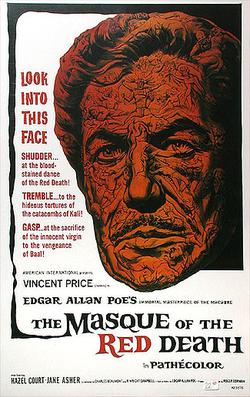
The Masque of the Red Death 1964 Film


-The film is far different from the short story. Although the basic idea is the same - A disease is killing off a Prince's population, while he enjoys a life of luxury secluded in his castle - Prince Prospero is a different character. In the short story, Prospero is described as mad but he and his guests are indifferent to the outside world. However, the Prospero in the movie takes pleasure in making the lives of those in and outside the castle miserable.

-In the film, Prospero worships Satan and brings in a village girl to try to corrupt her belief in God and convert her. This is not in the short story at all. The movie Prospero believes that Satan will protect him against the Red Death. His mistress, Juliana, also believed that Satan had spared her during her own sacrifice to become his wife. She was pecked to death by a crow.

-I prefer the Prospero in the short story even though he doesn't have as much detail, back story, or motive. Poe's Prospero is a coward with a false sense of arrogance. He fears the Red Death figure as soon as he sees him then becomes angry because he truly believed he had cheated death. The movie Prospero follows the figure, angry at first because someone defied his orders to not wear red, and then honors him because he thinks he is a messenger of Satan, his master. Then there is the relationship with Francesca, which also isn't in the short story. He wants to corrupt her but then asks for her to be spared. This is out of character to all of his actions in the film thus far and just adds another unnecessary variable to the story.

-One thing that remains true is that the Red Death is not portrayed as the main villain of the story. He is simply a part of the universe that cannot be stopped or controlled. The meeting with "Yellow Death," "Black Death," and "White Death" at the end seemed a little over the top and also unnecessary.

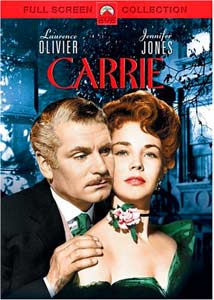
Carrie


-The movie shows Carrie in a MUCH more sympathetic life and her relationship with Hurstwood is more romanticized.

-Hurstwood's wife is portrayed as more than despicable and so the audience feels sympathy for him and understands his actions more.

-Even in poverty, the two are madly in love. What tears the two apart is not money, but that Hurstwood's wife reappears in their lives informs Carrie that they are still married and the stress causes Carrie to have a miscarriage. Carrie leaves Hurstwood to join the theater, but not because she resents him or doesn't love him anymore.

-Probably the biggest change in character is when Carrie and Hurstwood have their final meeting. She wants to take him in and share her wealth with him - not just give him nine dollars and send him on his way. It is Hurstwood who leaves her because he does not want to bring her down.

Sister Carrie: Carrie and Hurstwood


-Neither Carrie is not a usual Villain. She certainly isn't an outright villains like the other books I have read but I think she is a good example of a more every day villain.

-In the beginning, it would see she was the victim. Drouet feels sympathy for her low-income situation but he also wants to use his money as a way to sleep with her. But it is Carrie's own obsession with money and material items that lets Drouet do this. In return for clothes and nights out on the town, Carrie agrees to live with him without getting married. But Carrie is far from innocent. As soon as she sees Drouet next to Hurstwood, her attention begins to transfer to the more fashionable and wealthier man.

-Carrie dances between the two men, taking all that they give to her. She bathes in Hurstwood's love and the prospect of a good marriage, but accepts material gifts and acting roles from Drouet. Drouet was not the only one using Carrie, they were using each other. As soon as she found someone who she thought she could marry and bring her into even greater luxury, she leaves him.

-Carrie is so caught up in her own wants, that she does not realize the lengths in which Hurstwood has gone to runaway with her. After years of loyal service, he steals ten thousand dollars from work. Not that Hurstwood is completely innocent here. On the contrary, he lied to Carrie to get her to runaway with him, didnt tell her he stole the money, and married her without divorcing his wife. However, these are not the reasons why their relationship begins to fall apart - it is the lack of money.

-Once Carrie becomes friends with her neighbor, Mrs. Vance, she once again has a taste of the upperclass in New York, which is on an even higher scale than Chicago. Carrie begins to become dissatisfied again. When Hurstwood loses his job, stops dressing well, and puts a cut off on Carrie's spending, things begin to go very sour. It was at this point in the book that I began to wonder if Carrie had ever loved Hurstwood in the first place or if it is as I have said in this blog - it was only his wealth and status in Chicago's society that fascinated her.

-They begin to resent each other, until finally Carrie finds work on her own as an actress under the name, "Carrie Madenda," which Drouet had given her. Carrie ends up leaving Hurstwood with 20 dollars and note to live with Lola. Free of Hurstwood, Carrie's career begins to take off. After becoming successful she encounters both Drouet and Hurstwood the same night. She feels pity for Hurstwood and gives him money, but does not seem to take any responsibility she may have had in his fall. Hurstwood ends up killing himself, Carrie remains successful but unhappy. She does not seek out information about him and dos not know that he has died.

The Masque of the Red Death: Prince Prospero


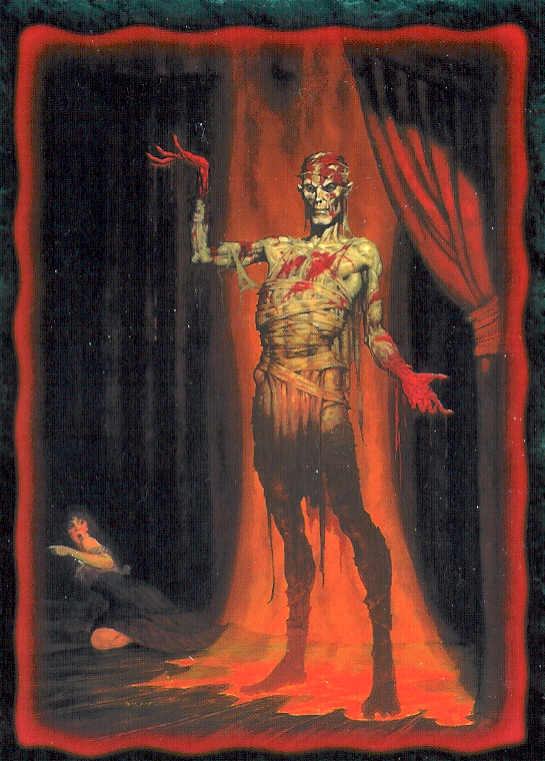
-The original assumption most readers make about Poe's short story, "The Masque of the Red Death," is that "Red Death" is the main villain. That it is the disease that is the primary evil of this tale. However, it is the main character, Prince Prospero, that is the true villain.

-As a prince, it is Prince Prospero's duty to govern and rule his people. But in a time of crisis, when half of his kingdom's population has died from the "Red Death," Prospero "was happy and dauntless and sagacious... he summoned to his presence a thousand hale and light-hearted friends from among the knights and dames of his court, and with these retired to the deep seclusion of one of his castellated abbeys" (pg. 1.) He abandoned his people for a life that "provided all the appliances of pleasure" (pg. 1). He believed that the "external world could take care of itself" (pg. 1).

-He has lavish parties where "there were buffoons, there were improvisatori, there were ballet-dancers, there were musicians, there was Beauty, there was wine. All these and security were within. Without was the 'Red Death'" (pg. 1). By running away from what he is afraid of, Prospero thinks that not only can he cheat the "Red Death," but that he is more powerful than it.

-At his most over the top masquerade party, with seven rooms of different colors, a figure, personifying the "Red Death" appears. The other guests and certainly Prospero are frightened and outraged but as a Reader I not only found the figure as just a natural part of the world Poe had created but also welcomed him to punish Prospero for abandoning his people.

-"And now was acknowledged the presence of the Red Death. He had come like a thief in the night. And one by one dropped the revellers in the blood-bedewed halls of their revel, and died each in the despairing posture of his fall. And the life of the ebony clock went out with that of the last of the gay. And the flames of the tripods expired. And Darkness and Decay and the Red Death held illimitable dominion over all" (pg. 6). The obvious point of the story is that no one can outrun death. Prince Prospero tried to use his power and wealth to do so but in the end he and all of his guests were killed. What makes Prospero a villain is that he could have tried to help his people, done his duty, and maybe help save some lives but instead he ran away and was arrogant enough to believe that if he turned his back on the world that the world could not make him turn around and face reality.

Snow White and the Seven Dwarves


- The Disney version of Snow White obviously has a much lighter tone than the Brothers Grimm version. The message is still the same, but the actions less grotesque.

- The Queen still asks for one of Snow White's organs, but it is the heart not the liver and lungs, and she keeps it in a box. This is a step below cannibalism.

- She only tries to kill Snow White twice, however, she does go to a greater length that the Queen in the story by actually transforming herself into a hag. The Brothers Grimm Queen merely disguised herself with make up and a costume. The Queen in Disney's version, actually changes her shape. I would argue that although this Queen's methods are less barbaric, she might be even more blinded by jealousy in that not only does she not care if she dies trying to kill snow white but also has given up her beauty to do so (yes, she can change back but that she could even live with looking so ugly is an important detail to note).

- Disney's Evil Queen also dies at the end of the story but not in the same way. Instead of being tortured and humiliated, she falls from a cliff, while trying to crush the dwarfs with a boulder. Although the Brothers Grimm's Queen dies beautiful, I think falling to one's death might better than dancing to death in burning hot slippers in front of the person you hate the most. The Disney Queen at least thought she had succeeded and that Snow White had died, but the original Queen's last living image is of Snow White having everything.

Fairy Tales of the Brothers Grimm: Snow White


-It is no secret that the earlier versions of fairy tales are much darker than the modern Disney movies, however, the story of Snow White is particularly grotesque.

-The Step Mother has no back story. The reader knows that she came to the castle "proud and haughty, and she could not tolerate anyone else who might rival her beauty" (pg. 196) but we don't know why. It isn't for fear that she might lose her husband's attentions, after the first page of the story he isn't mentioned again. Like Marquise de Merteuil, it is her own ego and vanity that fuels her.

-The main theme of this story is to be wary of envy and jealousy, for these feelings can drive a person to do unthinkable acts and the consequences maybe grave. In the case of the Queen, she not only tries to kill her stepdaughter four times but also wanted to eat the poor girl's liver and lungs. She wants to be the "fairest" so badly that even if "it costs [her] life" (pg. 201) she will kill Snow White. She is so blinded by jealousy that she doesn't realize with both of them dead, she will still not be the fairest in the realm.

-The consequences for her actions are just as cruel and severe as her own attempts to kill Snow White. She is forced to wear iron hot slippers and dance until she dies at Snow White's wedding. In the end, not only was Snow White the fairest but also Queen.

Monday, December 7, 2009

Cruel Intentions: Sebastian Valmont and Kathryn Merteuil


- Up until Sebastian's death, the basic story is almost identical to "Les Liaisons Dangereuses" only with a modern setting.

- The character most changed is Sebastian Valmont. Because the movie is not told through letters, the audience can see his actions first hand and therefore feel more secure in believing that he is in fact in love with Annette (Madame de Tourvel). Unlike in the novel, Sebastian sacrifices his life for Annette by pushing her out of the way of an oncoming cab and uses his dying breath to confess his love for her. This is an even greater transformation that original Valmont, making Sebastian seem more like a troubled teen than a villainous womanizer, destroying the lives of women for his own ego and sport. This has a lot to do with the modern setting - a girl who has sex before marriage in 1999 was seen a lot differently than a woman doing the same thing in the 1700's. Annette does not end up falling ill and dying after Sebastian's death, but keeps his diary as a memory to carry with her through life and his Jaguar, which Kathryn, again the true villain, desperately wanted.

- Kathryn Merteuil also seems less villainous because it is a modern setting. The consequences have less magnitude and therefore her actions seem less vile. Her sickest act is at the end, where she is giving the speech at Sebastian's funeral. There is something very rewarding for the audience to see her being brought down by Cecile since, in the novel, Cecile returns to the convent. Kathryn loses her reputation like Merteuil but not her looks. Besides Sebastian, everyone in "Cruel Intentions"receives a happier ending than in "Les Liaisons Dangereuses."

Les Liaisons Dangereuses: Marquise de Merteuil and Vicomte de Valmont


- I chose "Les Liaisons Dangereuses" because I knew it has the inspiration for the movie, "Cruel Intentions," which is one of my favorite movies. Marquise de Merteuil and Vicomte de Valmont are villains of self indulgence and the evil that can come from privilege, vanity, and boredom. Still, they are not exactly the same type of villain.

-In the beginning, their motives are the same. They reward their vanity and egos through the conquests and destruction of others. When Merteuil asks Valmont to seduce the young Cecile as revenge against her former lover, who is meant to marry Cecile, Valmont's response is, "What is it that you suggest to me? To seduce a young girl, who has seen nothing, knows nothing, who would be, so to speak, delivered defenseless into my hands, whom a first compliment would not fail to intoxicate, and whom curiosity will perhaps more readily entice than love. Twenty others can succeed and these are as well as I. That is not the case in the adventure which engrosses me; its success ensures me as much as glory as pleasure” (pg. 19) Valmont has reached a point in his conquests that merely sleeping and ruining a girl's life is not enough of a thrill.

-His current "adventure" is the Madame de Tourvel. She is married, pious, and has been warned about his ways. This only makes Valmont want to conquer her more. He writes to Mertuil saying,“I shall possess this woman; I shall steal her from the husband who profanes her: I will even dare ravish her from the God whom she adores. What delight, to be in turns the obect and the victor of her remorse! Far be it from me to destroy prejudices which sway her mind! They will add to my happiness and my triumph… I shall be truly the God whom she has preferred” (pgs. 24-25) By sleeping with Tourvel, his ego will be satisfied on such a level that he will be on a God-like level.

- An important aspect to "Les Liaisons Dangereuses" and its characters is that it is told through letters. Therefore, the reader has to decipher for themselves what they believe is true and just rumor. Does Valmont actually fall in love with Madame Tourvel, or is she just another one of his conquests? Is he has bad as Madame de Volanges says in her letters to Madame de Tourvel? That “He can calculate to a nicety how many atrocities a man may allow himself to commit, without compromising himself; and, in order to be cruel and mischievous with impunity, he has selected women to be his victims. I will not stop to count all those whom he has seduced: but how many has he not ruined utterly?” (pg. 29) Merteuil is able to make Valmont leave Madame de Tourvel, even if it was through manipulation, and in the end he is a major factor in her death.

- Besides Valmont and the reader, all of the other characters in the book do not know the extent of Merteuil's villainous schemes and manipulations. Even Madame de Volanges is fooled by her, saying, “The Marquise de Merteuil is the single exception to this general rule; she alone knew how to withstand and disarm his villainy.” (pg. 29) Merteuil becomes the main villain of the story and Valmont a deathbed hero because she not only lies to those around her but to her partner in crime. She alienates herself as the true deceiver. Valmont dies in a duel, a gentleman's death, and exposes Merteuil. She has to live the rest of her life in exile and has lost her beauty, and thus her ego and vanity, to illness. In the case of Merteuil, a scarred appearance and ruined reputation is worse than death.

Sunday, November 15, 2009

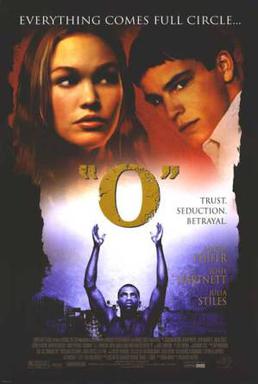
O: Hugo


- "O" is a modern interpretation of Shakespeare's Othello centering around a Basketball school at a private boarding school. Josh Hartnett portrays Hugo, the character based off Iago. Although the story remains pretty faithful to the original just set in modern times, Hugo has different motivations than Shakespeare's Iago.

- In the movie, the Duke is Hugo's father and the coach of the basketball team. And his favoritism of O both on and off the court is an obvious motivation for Hugo's manipulation of Odin, Desi, Michael, Rodger, and Brandy. Even before he begins to set his plans into motion, we know that he has been taking steroids to improve his performance on the team and thus impress his father.

- Like Iago, everyone seems to like and trust Hugo yet he is left in the shadows while Odin and Michael receive the school and his father's praise. This is particularly apparent during the scene where the Duke gives a touching speech about Odin before naming him MVP, even going so far as saying, "I love him like my own son." Hugo feels like Odin is not only stealing his spotlight on the basketball court but also from his father.

- It does seem like in the end, both Hugo and Iago did just want to be noticed, to be recognized and get attention. But who they receive this attention from is different. It's questionable from who exactly Iago wants attention from - the world? The Duke? His country? Fellow soldiers? All of the above? With Hugo, his father is definitely someone he wants attention from. Not solely his father, but from his monologue at the end that the Duke was a large part of his motivation.

- The perception of Iago and Hugo as villains are different because of the changes in motivation. I personally find Iago more interesting as a character because his motivations are less clear. He isn't just trying to get daddy's attention. Hugo seems just as spoiled as the kids he goes to school with and is jealous of. That makes him hypocritical and, in my opinion, unimpressive. What Hugo does have going for him is that an attractive actor is playing him.

Sunday, October 25, 2009

Othello: IAGO


- Iago is arguably one of the greatest villains of all time. Through manipulation, he destroys five people's lives (not including his own) and for what? Because Othello made Cassio his Leutinant and not him? Doubtful. Like the rest of the play, I think what drives Iago is jealousy. He is jealous of Othello's military success and social status, of Cassio's looks, and that Desdemona is more beautiful than his own wife.

- In the very first scene, Iago has already begun to set his plans into motion by enlisting Roderigo as his partner by making him believe that he can have Desdemona if his plans work out. Iago explains that he hates Othello and Cassio and wants to bring them down because Othello promoted Cassio. He tells Roderigo to tell Desdemona's father about her relationship with Othello.

- By scene 3 we know that Iago has already manipulated Othello's trust when Othello refers to him as "Honest Iago" (pg 826) and leaves Desdemona in his care. This allows Iago to use his wife, Emilia, in his plans since she is Desdemona's maidservant. Eventually, Iago betrays three key relationships: friend and friend, husband and wife, commander and soldier.

- The strength of Iago's manipulation comes from the private conversations he has with each of the main players. For example, to Roderigo Iago says that Desdemona only lusts after Othello and once "the blood is made dull with the act of sport, there should be again to inflame it, and to give satiety a fresh appetite, loveliness in favour, sympathy in years, manners, and beauties, all which the Moor is defective in" (pg 829). This gives Roderigo further hope that with Othello out of the way, he can be with Desdemona.

- With each character, Iago finds what they want, sees it as a weakness, and exploits it. Othello and Roderigo want Desdemona. Cassio wants to be Lieutenant again. Desdemona wants Othello. Emilia wants Iago. And because he has built up this
persona of being "Honest Iago" and has made them distrustful of each other, they all believe him.

- I have read Othello a few times now and every time I read it I wonder what was Shakespeare trying to say with Iago? Besides the power of jealous what is it that Iago exposes? And I would say that although he is a great actor and manipulator, the bonds between the other characters were not as strong as they believed them to be. There were so many places and times for Iago's plans to go wrong. If any of these characters just talked to each other honestly then they should have realized what Iago was doing. Iago exposes the insecurities in ourselves and the jealousy that comes out of these insecurities.

MERLIN


In the literary medium, the themes of villainy of Lancelot, Guenevere, and Mordred are Greed and Betrayal. I kept my previous post in mind while watching the 1998 miniseries, "Merlin." From the start I knew that there would be some major differences since the main character of "Merlin" is not Arthur like in Le Morte D'Arthur. But I was surprised to find how different the perspective of Lancelot, Guenevere, and Mordred were different because this story was written so many years later. The following are points of differences between the two mediums and how those changes make the characters a different kind of villain.

- The main villain of Merlin is Queen Mab. It is the battle between Merlin and Mab that drives the story. Arthur, Mordred, Guenevere, Lancelot, etc are all just accessories to this greater battle between "the old ways" and what is just. Mab represents the fear of change, of hanging onto the past and tradition even if it isn't what is "good." To show that she is a villain, her voice is raspy, she wears lots of black, and moves in a quick twitchy like manner. All of the villains in this miniseries besides Uther and Vortigern have similar makeup.

- Mordred is a pawn of Mab. Her greatest and most dear pawn - her last hope - but a pawn nonetheless. In the film, he is shown as being "bad" from the start with his incestuous birth and attitude even as a little boy. He is raised with the purpose of destroying Merlin and Arthur. He reveals Lancelot and Guenevere's relationship to Arthur at the same time that he meets him, while in "Le Morte D'Arthur" he was a member of the round table. This makes his villainous actions more about vengeance rather than betrayal. The film version of Mordred was a lot less interesting to me than Mallory's because of this. The idea that he is raised by "villains" so he becomes a villain and just carries on his role is very one dimensional. Most of the time he is overshadowed by his mother, Morgan Le Fay, because she is more sympathetic and has a love story with Frik. Her hatred of Merlin is also much more understandable.

-Lancelot and Guenevere's relationship was also changed in the film. In the film, Arthur leaves for years in the search of the Holy Grail and Lancelot is entrusted with Camelot. He and Guenevere have an affair but Merlin knows about it. This seems less about the idea that "Adultery is bad" and more about "The consequences if this relationship is found out will be bad." Merlin even admits he might have been too hard on the lovers when puts the sole blame upon Lancelot for his (Lancelot's) wife's death. In the film, no one else suspects the two until Mordred, who has been told by Mab, shows up and reveals their relationship the moment Arthur returns from his search of the grail. Their relationship is seen in a sympathetic, relate-able light. Arthur and Guenevere did not marry for love, she was alone for years, and she fell in love with Lancelot. Guenevere even defends the affair by pointing out how long Arthur left her alone. In Mallory's tale, however, Arthur merely goes on a fake hunting trip and the two lovers are discovered by the knights of the round table. Because not even Arthur wants to condemn Guenevere neither do we. It is Mordred's manipulation about equality that forced Arthur to put Guenevere in the line of fire. Like in "Le Morte D'Arthur," Lancelot comes to her rescue but in the film that is the end of it. We do not know if they just stay together or if they both do commit themselves to God in repentance.

- Mordred and Arthur's deaths are also seen in a totally different light. In the film, Arthur hesitates when Mordred points how that by killing him he will be committing another sin because he will be killing his son. In Mallory, Arthur delivers the fatal blow and then Mordred, knowing he is going to die, pushes himself further on the spear to get close enough to also kill Arthur.

Sunday, October 4, 2009

Le Morte d'Arthur


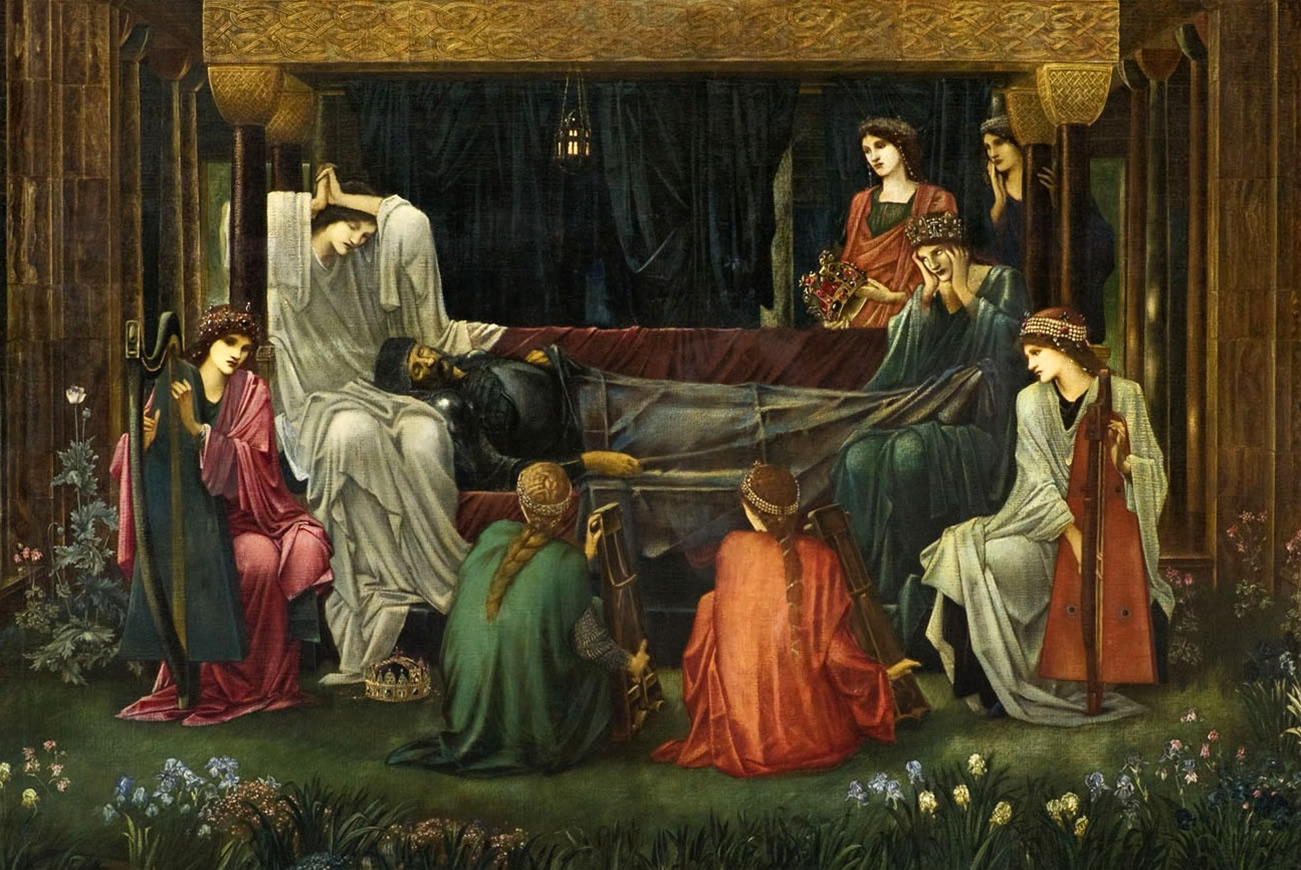
I think it would be difficult to have grown up in the West and not know some basic details of the Arthurian Legend. At the very least, most people have seen the Disney movie. There even was just recently a mini series called, Merlin. But I don't know how many people have actually read the legends. I wasn't one of them and I still haven't read them all. For this independent study I only focused on the death of Arthur, the end of the tale. Because of this, I came into it with my own ideas of what happened and of who the bad guy was. But as I read the story I realized there wasn't just one clear cut villain in "Le Morte d'Arthur," but that there were villainous themes that characters, including the famed Lancelot, followed. The two main villainous themes of this particular story are greed and betrayal (which usual comes out of greed).

The three characters that represent these themes the most are Lancelot, Guenevere, and Mordred. The betrayal of Lancelot and Guenevere is obvious and a well known tell. Lancelot is the supposed best knight of the round table and "the Kynge loved hym passyngly well" (pg. 647). Guenevere was the Queen. It was the most forbidden union, the ultimate betrayal. It was also the perfect chance for Mordred's greed for the throne to strike. He and Agravaine tell Arthur his suspicions and with 12 knights they wait for Lancelot, who believes the other knights and the king to be out on a hunting party, to visit the Queen. Even when one of his men try to warn Lancelot not to visit the Queen and that Agravaine is up to something (pg. 648) he visits the Queen anyways. Lancelot escapes but only by killing some of the knights. The main difference between Guenevere and Lancelot is that they know that they have wronged Arthur. To go back to my opening about the general public's knowledge of Arthurian legend, most people know that Lancelot comes to rescue Guenevere. This is true but in the legend they do not end up together. Guenevere becomes a nun and Lancelot a monk to repent for their sins. It is the repentance that the legend portrays them in a sympathetic light and also puts them on a lesser level of villainy against the protagonist as Mordred, who receives a violent death. This is further shown when the legend states that "the nyne knyghtes put Syr Launcelot in the same hors-bere that Quene Guenevere was layed in tofore that she was buryed" (pg 696). The message the legend is trying to send is clear: Adultery, even by good people in love, will result in destruction. The round table is broken and many men died and the affair of Lancelot and Guenevere was the source. This is relevant to my study because it shows that a character, which had been seen as a hero for the majority of the story, can become a villain of the story.

Mordred is on another level than Lancelot and Guenevere because he uses their relationship to betray Arthur as well and start a war resulting in the death of Arthur. And although he is a knight of the round table, from his birth (he is the illegitimate child of Arthur and his half sister, Morgan Le Fay) it is foreshadowed that Mordred will be a villain. While Arthur goes after Lancelot, Mordred claimed that Arthur was dead and usurped the throne. This leads to an epic battle between father and son, king and traitor, and they kill each other:
"And Sir Mordred saw Kynge Arthur, he ran untyll hym and hys swerde drawyn in hys honde; and there Kyng Arthur smote Sir Mordred undir the shylde, with a foyne of hys speare, thoroqoute the body more than a fadom. And whan Sir Mordred felte that he had hys dethys wounde, he threste hymselff with the myght that he had upp to the burre of Kyng Arthur's speare; and ryght so he smote hys fadir, Kynge Arthure, with hys swerde holdynge in both hys hondys, uppon the syde of the hede, that the swerde perced the helmet and the tay of the brayne" (686).
To his last breath, Mordred is hateful and greedy. Unlike Lancelot and Guenevere, who repent and mourn, Mordred is murderous even while dying.